Stop Fighting Alone
June 21, 2026Pastor Geoff Morin presented today's message, "Stop Fighting Alone." A video of today's message is here on YouTube. It may help to be familiar with the message but that is not required to enjoy the thoughts below.
This was the third message in a summer series on the Jehovah names of God. Today's name was Jehovah Nissi (Lord is My Banner).
The Hebrew word nissi (נִסִּֽי) can mean banner, flag, pole, ensign, sail, standard, and generally a sign or signal. Though the name Jehovah Nissi is used only once, the word is used about 21 times in the Old Testament. For example, Isaiah 62:10 reads "Raise a banner for the nations." (NIV).
See the article: What is the meaning of Jehovah-Nissi?. It makes a couple points that resonate with me:
1. "The hands and rod of Moses were held up in the same way that soldiers hold up their flags in the time of battle. As these flags bear the insignia of their country, the soldiers are said to fight under that banner. The Israelites fought under the direction of God, Jehovah-Nissi. It was under the Lord's banner and with His aid they fought, and in His name and strength they conquered."
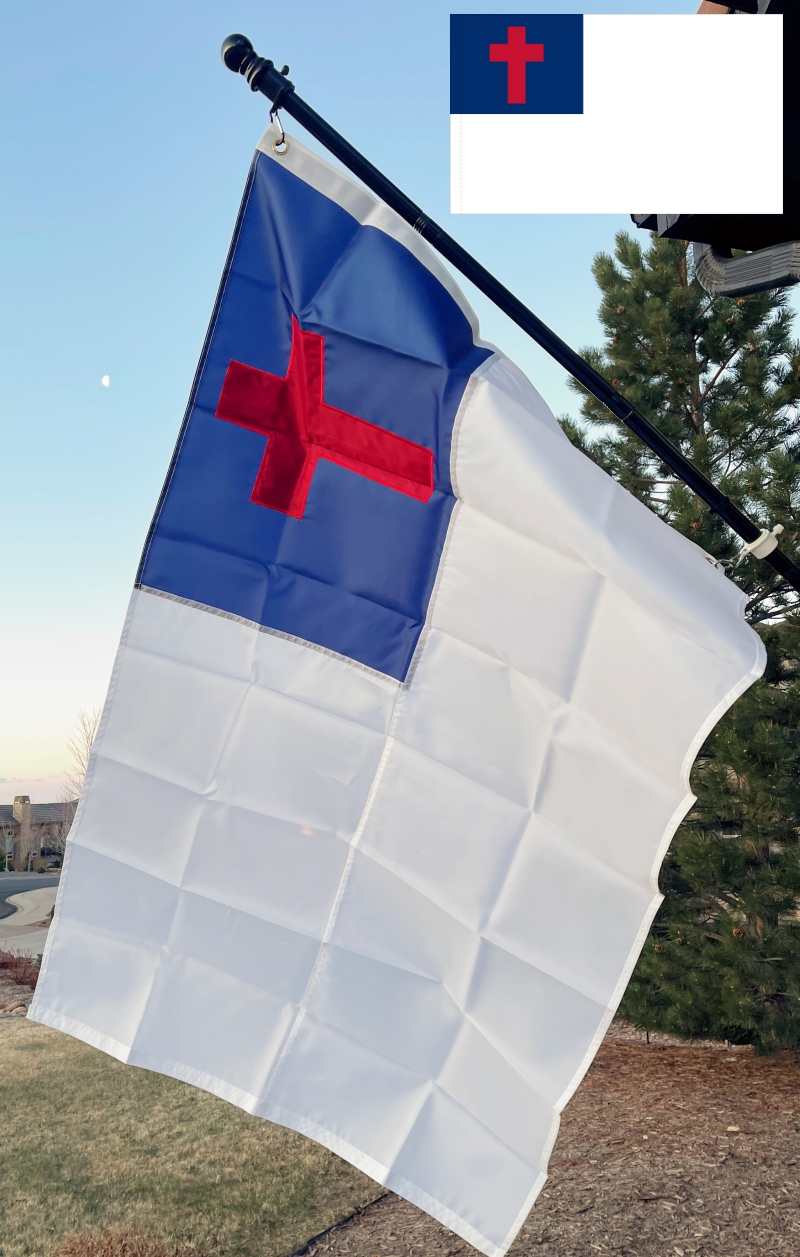 It happens that I collect flags, mostly flags of and within the U.S., both historical and current. Flags do make a statement when flown, whether in battle, at City Hall, or at home. Historically, flags were used as rallying points. My collection is documented on this website: Jamie's Flags. Let's not forget that our national anthem refers to the U.S. flag as "that star spangled banner." Pictured here is a Christian flag like the ones I grew up with in mainline protestant churches. Understand, however, that there is no one Christian flag.
2. "Moses' lifting up of the rod can thus be seen as a picture of intercessory prayer [praying on behalf of others]. 'The prayer of a righteous person is powerful and effective' (James 5:16)."
It's interesting to note that other sources trace the Hebrew word to a root meaning refuge, and thus the name becomes "Lord is my Refuge." And yet another suggests nissi can mean "to lift up," giving the "Lord is my Exaltation."
It's also interesting to note that the rod Moses held in Exodus 17:15 was the same rod used to perform miracles in the Wilderness (e.g. getting water from the rocks) and could well have also been the rod Moses used during the Ten Plagues of Egypt and the parting of the Red Sea.
While God is referred to as Lord is My Banner only once in the Exodus passage, there are other times when God and banner are mentioned. "You have raised a banner to save us and help us with your right hand, that those you love may be delivered" (Psalm 60:4, 5, NIV). And "We will rejoice in your salvation, and in the name of our God we will set up our banners!" (Psalm 20:5).
Isaiah specifically links the Messiah to the banner imagery: "In that day there shall be a Root of Jesse, who shall stand as a banner to the people. ... He will set up a banner for the nations" (Isaiah 11:10,12).
The word nissi in Biblical Hebrew has led to the word nes in modern Hebrew meaning miracle. This suggests that the banner of God is miraculous. The Jewish celebration of Hanukkah includes "a great miracle happened there" (the lamp oil lasted much longer than could be expected) with the word nes translated as miracle.
There is a hymn called "The Banner of the Cross" by D. W. Whittle (1884).
Bonus
Psalm 92: The Song of the First Sabbath
By David Nekrutman: "Adam committed the sin. He knew he was guilty. The punishment was just, the execution deserved. But instead of judgment, mercy came. And from that mercy, a song was born in Adam's heart: the song of the first Shabbat. Standing at the Cave of the Patriarchs and Matriarchs in Hebron, we open Psalm 92 and find exactly that: a song of survival composed in the shadow of a death sentence that mercy swallowed whole. The message has not aged a day. Every breath is a gift. Every Shabbat is another mercy, another opportunity to sing along with Adam from Psalm 92."
For the 9-minute video: The Song of the First Sabbath.
While you're there, be sure to read the text below the video, titled "The Cave of the Patriarchs."
Let me know what you thought...