The Reason You're Stuck
January 4, 2026Pastor Patrick presented today's message, "The Reason You're Stuck." A video of today's message is here on YouTube. It may help to be familiar with the message but that is not required to enjoy the thoughts below.
At one point, Pastor Patrick had a good time this morning talking about the dialogue between Adam and Eve. He playfully pointed out how they deflected responsibility for eating the apple. The tangent I'm going to take today is to look at other fun/interesting portions of the Garden story. See Dennis Prager's "Rational Bible Series: Genesis."
God made the snake. It was not supernatural or a deity.
If the snake went to Eve first thinking she would be the easiest to convince, it was sorely disappointed. The snake may have thought that as Eve got the command second hand from Adam. Turned out Eve was very hard to convince whereas Adam responded to a simple "Eat."
The snake deliberately misquoted God. God never said, "don't touch." Lying is a typical tactic of evildoers. Lies are the root of all evil. And Patrick might add "including lying to oneself about the role you played in something bad."
The only other talking animal in the Old Testament is Balaam's donkey (Numbers 22:28-30).
The snake can be seen as a mobile digestive track, all appetite. And the slithering can be seen as cunning, willy, or clever.
Eve says the reason is "it will kill you." The real reason is that it's forbidden.
The snake's attack plan included three levels/lies: overstate the prohibition, attack God's motive, and suggesting the two will benefit greatly by eating the apple. It's an attempt to displace God as the moral authority - which happens all the time even today. When you decide for yourself what's right and wrong, you are being your own god.
To her credit, Eve did not use Adam as a guinea pig, she went first, buying the snake's argument. Eve concluded the snake was right as she did not die. Adam followed readily. She bought it all, however misconstrued. She mixes what she heard and what her mind told her. This is how we are misled into accepting as whole truth things that are only partial truths.
Blaming others is as old as humanity. Someone quipped, "Humans need four things: air, food, drink, and someone to blame."
Unlike the serpent, God did not say curse, He said punish. Childbirth pains were increased at this point, not created. The bottom line message is that God will no longer protect Man from nature anymore. That does not prevent Man from trying to overcome the harshness of nature.
Lastly, for now... Note that God does not interrogate the snake. Evil cannot be negotiated with.
Bonus
A Rabbi Answers the Hard Questions
From the 16-minute video description:
What happens when a former DJ, martial artist, and world traveler becomes a rabbi?Here's the video: Sex, Drugs and Martial Arts — A Rabbi Answers the Hard Questions | Rabbi in the Hot Seat. Note this is Episode 1...
Speaking from Jerusalem, Rabbi Dov Ber Cohen sits in the hot seat to answer the real questions people are actually asking — about sex, drugs, spirituality, guilt, identity, and what Judaism really says about living a meaningful life.
- 00:00 Meet the Rabbi
- 00:58 How can Jews value peace and still learn to fight?
- 2:06 Why do observant Jews drink, smoke, or take drugs?
- 5:37 Does God care who we sleep with?
- 9:54 Is Judaism about guilt — or growth?
- 14:10 Should Jews forgive the Nazis?
Bonus2
Master's Program with Dennis Prager
The Master's Program with Dennis Prager consists of ten video episodes ranging from about 30 to 45 minutes each in which Dennis covers these topics:
Consequences of Secularism, Part I
Consequences of Secularism, Part II
Happiness is a Moral Obligation
Is Human Nature Basically Good?
Differences Between the Left and the Right, Part I
Differences Between the Left and the Right, Part II
Hurdles to Happiness
Differences Between Men and Women
The Case for Marriage
How to Be a Good Person
Here's the trailer. This should be required course work for everyone.
Bonus3
Epiphanies about Epiphany
The Greek word Epiphany (epiphaneia, ἐπιφάνεια) means appearing or manifesting. Typical things "appearing" in the Greek world then were the dawn, an enemy, and/or a deity. What is appearing or being manifested at Epiphany differs from observance to observance: Jesus' birth, Jesus becoming known to the Gentiles, Jesus' deity through miracles (Wedding at Cana), and/or the Baptism of Jesus. In common use today, an epiphany is a sudden realization or understanding, a striking grasp of reality all in a moment, and/or a revealing scene.

Celebrations of Epiphany around the world are about as varied as celebrations of Christmas. Epiphany dates fluctuate even more. For example, pictured above is an Epiphany celebration in the Greek Orthodox world that involves throwing a cross out into a body of water and having a contest to see who can retrieve it. The water focus has to do with the water-to-wine miracle at the Wedding at Cana or Jesus' Baptism. I've read there's a similar and rather large event along these lines in Tarpon Springs, Florida. Some Russian celebrations involve cutting a large cross-shaped opening in the ice and having a cold plunge.
In the Western Christian world, Epiphany is typically set for January 6. Catholics tend to make a bigger deal out of it than do Protestants and non-denominationals. The focus is on the arrival of the Three Wise Men. Or is it Three Kings? Three Magi? The Greek word in the Matthew 2:1-12 story is Magi (magoi, μάγοι) meaning wise men, sorcerers, or magicians. By extension, Oriental scientists. But definitely not kings.
There are some missing pieces of information in the Matthew story. The story does not say how many there were. The number three probably settled in because there were 3 gifts mentioned. But we have no idea how many Magi there really were. We also don't know exactly where they're from. "From the East" describes a large territory. Nativity scenes typically show a Persian, an Arabian, and a Babylonian or an Ethiopian, but that's just what has settled in after centuries of celebrations. The names are not given in the text, but again tradition has settled on Melchior (often depicted as an older man from Persia), C(G)aspar (a younger man from India or Arabia), and Balthazar (a middle-aged man from Babylon or Ethiopia).
There's no information in the Biblical text about exactly when the Magis' visit happened. Most scholars agree it was somewhere between several months to two years after Jesus' birth, travel time included. The text does say the visit took place in a house, not a barn or manger, so it had to be well after the birth, shepherds, etc. The Star is mentioned only in Matthew. It could relate to fulfilling the "Star Prophecy" in Numbers 24:17. See the Star of Bethlehem entry in Wikipedia for lots of detail.
In 567AD, the Council of Tours set the date for Epiphany which predates the setting of the date for Christmas. For the westerners, the 12 Days of Christmas would become the period between Christmas and Epiphany. The eve of Epiphany would thus become Twelfth Night (as in the Shakespeare play, 1601). On Twelfth Night (Epiphany Eve), for instance, in some parts of the world, children would put shoes or boxes under their beds with straw in them for the camels. The next morning, the straw would be gone and presents would be there. In some cases, naughty children got charcoal or dirt.
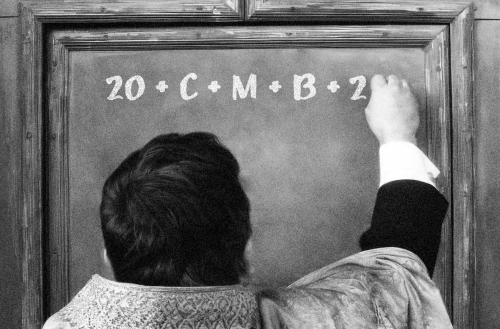
Another interesting Epiphany practice is Chalking or Blessing of the House. The priest or church leader goes from house to house and marks above the door: XX + C + M + B + YY, where XX are the first two digits of the year and YY are the last two digits of the year. The + symbols are crosses. And the C, M, and B are the initials of the Magi: Melchior, Caspar, and Balthazar. CMB is also the initials of the Latin "Christus mansionem benedicat" which means "May Christ bless this house." Remember, the Magi visited a house, not a barn.
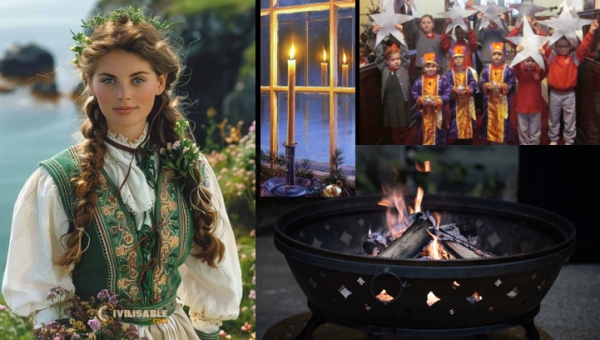
The Irish have some interesting takes. Epiphany is called "Nollaig na mBean" meaning Women's Christmas. It was time for women to relax after all the hectic work of the Christmas season. Rooms of houses would be blessed with water (Wedding at Cana and Jesus' Baptism). A strip of holly or greens from the decorations of the season would be burned. And a candle would be put in the window to help the Magi find their way. And it's very unlucky to remove Christmas decorations before Epiphany. In some Irish and Amish circles, Epiphany is called "Little Christmas" or "Old Christmas." This harkens back to the fact that January 6 used to be the date for Christmas. "Little Christmas" is also the name of a figure in Irish set dancing where the females take the male role on the outside of a turning circle.
We need to include Candlemas in this discussion. Candlemas comes 40 days after Christmas and for some marks the end of the Christmas season. This celebrates the presentation of Jesus by his parents at the Temple (Luke 2:22-40). It's referred to as the Feast of the Presentation of Jesus Christ, Feast of the Purification of the Blessed Virgin Mary, and/or Feast of the Holy Encounter. After Candlemas, all the candles of the season are taken to the church for blessing and continued use. This relates to an Old Testament reference in Leviticus 12 describing the requirement for a mother to visit the Temple 60 days post-partum.
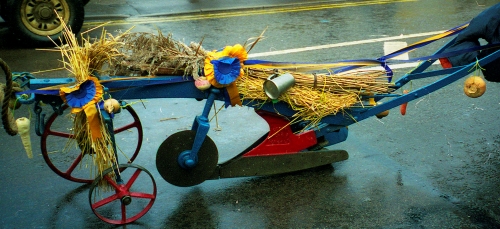
Plough Day, which began in the 15th Century, is the day after Epiphany in some British areas and marks the start of the agricultural year. Thus, a ploughshare is a key element which is blessed in the church the Sunday before Plough Day. A ploughshare is typically paraded around town past shops and homes to collect money.
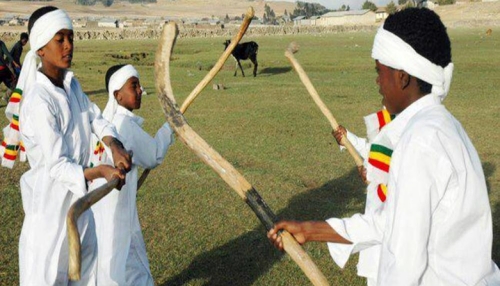
In Ethiopia, Protestants and Catholics alike celebrate Epiphany. One of the major features is playing Gena, a form of field hockey. This is because the sticks resemble shepherds crooks.
There are over 40 different countries' Epiphany practices outlined in the Wikipedia entry.