Community Isn't Enough
August 10, 2025Pastor Travis Deatherage presented today's message, "Community Isn't Enough." A video of today's message is here on YouTube. The discussion that follows assumes you are familiar with the message content.
The "Peace Offering" (sacrifice) of the Torah (Leviticus 3:1-17; 7:11-34; 19:5-8; 22:29-30) has been referred to as the "Fellowship Offering." The suggestion is that fellowship combined with a meal, which is part of the sacrifice, brings peace, including peace with God. It seems that the tendency of churchgoers today to fellowship around food has very old roots. For a detailed discussion of this notion, see The Fellowship Offering at Bible.org.
From the very beginning, God noted that Man should not be alone (Genesis 2:18). Of course, this was specifically in the realm of combining one man and one woman, but it does allude to doing things in fellowship. In the same story, God calls out to Adam, "where are you?" God shows up and converses.
Other examples in the Old Testament of extreme closeness, i.e. fellowship, with others and with God include:
- Friends who will walk through fire with you (Daniel 3:16-18)
- Being on the same diet together (Daniel 1)
- Standing in defiance of an ungodly governmental decree (Daniel 3)
- Standing together in court together as one (Daniel 3:16)
- Being thrown in the furnace together (Daniel 3:24-26)
Old Testament references to fellowship often include pledges and security. That is, the pledge between the fellowshippers provides some amount of security for each.
Psalm 55:14 recalls intimate fellowship: "We who once enjoyed sweet counsel together walked to the house of God in company."
Another aspect of fellowship that the Moses/Jethro story reveals is the ability to see and willingness to yield to the wisdom of others. Moses recognized the value of the advice he got from his father-in-law, Jethro, about how to run a society better. See Exodus 18:13-27. "So, Moses listened to the voice of his father-in-law and did all that he had said." The advice was about spreading out the workload in running this new nation, the Israelites. And Jethro was not Jewish; he was a Midianite priest! The Israelites had very mixed luck with Midianites across the Biblical accounts.
I could find very few times that an Old Testament Hebrew word was translated as "fellowship." However, a handful of words were sometimes translated as council, friendship, intimate, allied, coupled, joined, pledged, and the like. Some had a connotation of joined or connected "as if by magic or a spell." Others had the connotation of being "sweetened" or "relished" by whatever connection.
Towards the end of his message, Pastor Travis mentioned Psalm 51, and I jotted down verse 10a: "create in me a clean heart, O God." I wondered to myself if that's the same clean as in clean and unclean (pure/impure) animals for eating, for sacrifices, and for numerous other references. I learned from Dennis Prager that from the beginning of the Bible and throughout, clean/unclean, pure/impure really mean life-oriented and death-oriented. The Hebrew words are tahor (טָהֵר) and tamay (טָמֵא֒) which have no good English word translation but mean effectively "life focused or life capable" (tahor) and "death oriented, unrecoverable" (tamay). And indeed, the word used in Psalm 51:10 is tahor. The prayer in this verse is to make oneself life-focused in God's spirit.
Bonus
Biblical Genealogies are Not Boring
All of the text in this Bonus entry came from an email subscription I have with Biblical Excavations which is part of The Isaiah Projects. I encourage you to follow their work. Their mission: The Isaiah Projects is a ministry dedicated to creating and providing specific tools that will help Christians discover the Hebraic roots of their faith.
It's easy to dismiss the genealogies in the Bible as mere lists of names, but they offer an opportunity to excavate revelatory nuggets from the sacred texts. Take the tribe of Simeon, for instance. In Numbers 26:12-13, the sons are listed as Nemuel, Jamin, Jakin, Zerah, and Shaul. However, Genesis 46:10 provides a different lineup: Jemuel, Jamin, Ohad, Jachin, Zohar, and Shaul. In Numbers, we see Nemuel instead of Jemuel. The Numbers list has Zerah, but no Ohad or Zohar. Even the total number of sons differs—five versus six. How can we explain these inconsistencies?
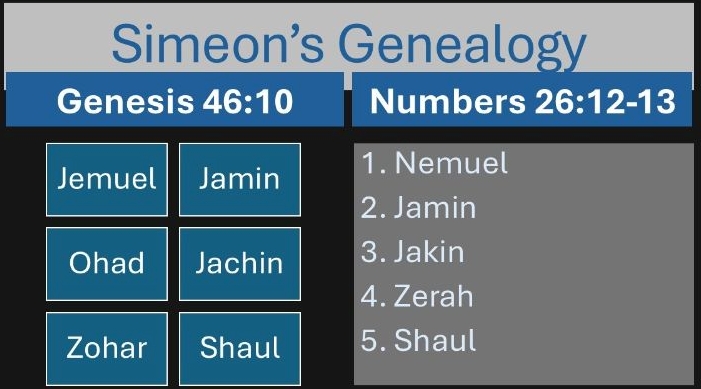
Academic circles, who do not believe in the divinity of God's word, are quick to assume these are scribal errors. As believers in His word, we attempt to mine revelation and meaning in every detail, even in seemingly simple discrepancies. The Numbers list appears after a traumatic episode in biblical history: the public execution of Zimri and Cozbi by Phineas, as well as a plague that killed 24,000 people from the Nation of Israel for consorting with Moabite-Midianite women and committing idolatry.
A possible revelation explaining the absence of Ohad is that they perished in the plague, and the Zohar clan changed its name to Zerah. In Hebrew, Zohar means "radiance," and Zerah means "shine." Realizing the gravity of their sin, the Zohar clan repented and changed their name to Zerah. This act reflects a profound belief that a name change can alter one's destiny, a concept seen repeatedly in biblical history. Think of how Abram and Sarai became Abraham and Sarah (Genesis 17:5), signifying this couple as covenant-bearers. Or Jacob's transformation to Israel (Genesis 32:28), marking his struggle with God and his new identity. And, of course, Hoshea becoming Joshua (Numbers 13:16), indicating his divinely appointed role in the mission to tour the land of Israel. These aren't just name swaps; they symbolize a shift in purpose - a new beginning. Life changes us, so a new name is a way of marking that history or inviting us to head in a new direction. It is possible that infer that repentance with a name change provided Zohar/Zerah an opportunity to reinvent themselves in the pursuit of God’s will.
I intentionally left the Jemuel/Nemuel puzzle untouched. Consider this an open invitation for your family to discover what "revelational nugget" you can unearth from that particular inconsistency!
OK, back to Jamie's words... If you come up with a thought regarding the Jemuel/Nemuel puzzle, let me know: Torah@JF2.com. I'll share your thoughts here and with The Isaiah Projects.