Daniel: How to Live Courageously
September 21, 2025Pastor Patrick presented today's message, "Daniel: Live Courageously." A video of today's message is here on YouTube. The discussion that follows assumes you are familiar with the message content.
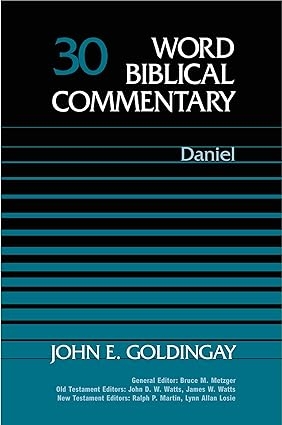 I apologize for the delay in getting my essay out this week; it's been one of those weeks. The good news is that the delay gave time for a new book to arrive: Word Biblical Commentary Vol. 30, Daniel by John Goldingay. I thought I'd just share a few of the thoughts in Goldingay's book about Daniel 3 (pp. 222-243).
I don't think I'd ever read the term "aretalogy" before. Goldingay suggests the story in Chapter 3 turns out to have the characteristics of an aretalogy, a study of someone's attributes or virtues, in this case, God's faithfulness.
The story in this chapter is about the King, Nebuchadnezzar who goes from blasphemer to blessing God (even if only "half converted."
This story in chapter 3 can be seen as an expansion of the story in Isaiah about attacking idolatry. The term "bow down" (סְגִד, worship) only appears in the OT in Isaiah and in Daniel, the latter ten times. It's a concrete reality that God protects His people in these stories. The only other time someone escapes judgment by fire is in Genesis 38 (see verses 24-26).
Here's Goldingay's summary: The king commands all to bow to the statue and the Judahite is sentenced. The king commands all to bow to God on High and the Judahite is saved.
The chapter shifts from the story to prayer and song, suggesting the importance of the latter. It's also interesting that three of the instruments mentioned are of Greek origin suggesting Greek influence at the time in Persia.
Daniel himself is absent from this chapter. Goldingay suggests that this may make the story speak more clearly to other "regular" Judahites. The three (Shadrak, Meshak, and Abednego) were not exactly "regular" Judahites, but they weren't any Daniel either.
Goldingay suggests the repetition of "six" in the description of the statue (e.g. 60 cubits) may symbolize imperfection or even evil (i.e. 666). The statue may have represented Nebuchadnezzar himself.
Note the progression of three men from youth in chapter 1 to friends of Daniel's in chapter 2, and now full-grown men in their own right here in Chapter 3.
In verse 23, we start seeing things not directly but through Nebuchadnezzar's eyes. Apparently, he's the only one to see the divine being in the fire. It's not clear exactly who or what is in the fire. God? An angel? A Messenger. The word used is malek (מֲלְאָךְ) which is translated most correctly as messenger, but often as angel, but could refer to God himself as in Exodus 3:2 (Burning Bush).
There was a great range of "bowing to idols" by the Judahites (Hebrews in exile). Some did so readily, others only as perceived necessary, and some would not bow down at all for any reason like our three here. Moses told the Israelites they would eventually do this in Deuteronomy 4:27-28.
The faith of the three men includes an understanding that still escapes many. That is, that God may not save them, at least not at this time and place. We know not God's plans and schedules.
These three have no expectation of resurrection or vindication. They will be dealt whatever cards are dealt in the afterlife. Their statements and actions are solely for God's sake. Their testing is in the flames AND in the threat of flames beforehand. On the other hand, in this story God in fact resurrects the three men.
Chapter 2 shows there's a God that can reveal the mysteries of the heavens. Chapter 3 shows there is a God who can intervene in individual and national life despite what man or men can throw at it.
King Nebuchadnezzar ends up making Judaism a recognized religion. The power of the Judahites God and the conviction of their commitment to Him bring the people to a level of political power.
Bonus
 Who Really Wrote "A Visit from Saint Nicholas"?
Was it really Clement Clark Moore, a wealthy Biblical scholar in Manhattan, who wrote "Twas the Night Before Christmas," or was it Henry Livingston, Jr., a gentleman farmer in the Hudson Valley?
That's the key question in a 2022 Hallmark Christmas movie titled, "'Twas the Night Before Christmas."
It's a cute one, and more than a little bit different. Find out who really wrote "A Visit from St. Nick" in this courtroom production! Maybe.
The original poem was published by the Troy Sentinel on December 23, 1823. There really was a trial at the Courthouse in Troy in 2013. You can listen to it on the weblink above. That 2013 trial ended with a hung jury. So, the case was retried in 2014. You can read and watch all about it on the website.
The movie is based on Duncan Crary & Jack Casey's "The Trial Before Christmas."