The Church I See
August 24, 2025Pastor Patrick presented today's message, "The Church I See." A video of today's message is here on YouTube. The discussion that follows assumes you are familiar with the message content.
In question form, the message's title becomes "What do you see in our church's future?"
Patrick mentioned the story of God allowing Moses to see the Promised Land (but not go over into it). Deuteronomy 34:4 (KJV), "And the Lord said unto him, This is the land which I swore unto Abraham, unto Isaac, and unto Jacob, saying, I will give it unto thy seed: I have caused thee to see it with thine eyes, but thou shalt not go over thither."
There's a miracle happening here that is not entirely obvious. Moses "sees" the Promised Land, the entire land, which is, of course, physically impossible. But that's what miracles are about, suspending the laws of nature for a moment or two. God "caused" Moses to see the Promised Land. The form of the verb also suggests that he saw more than just the land, he saw the future the land held, much like Martin Luther King, Jr. "saw" the future for our country. One lesson here is that truly seeing something in every sense of the word is a gift from God.
And that gets us to the Biblical Hebrew word for see, ra'ah (רָאָה). It's as loaded with meaning as is our word today for "see," maybe even a little more. It's used over 1300 times in the Old Testament in all manner of ways.
Ra'ah is what God was doing when he saw the various moments of Creation and said they were good.
Consider the various meanings that "to see" can impart today and Biblically:
to see (with one's eyes)
to see (figuratively)
to see right through
to inspect
to understand
to see where something is going (into the future)
to discern
to consider
to perceive
to realize
to know
to realize
to consider
to advise oneself
to gaze
to experience
take heed
to look at or upon (to inquire)
to regard
to view
to stare
to learn about
to distinguish
to reflect
to behold
to gaze at (with joy)

As you ponder the church you see, consider these many facets of the exercise. Particularly note the suggestions of discernment. Look for the Holy Spirit. Reflect upon what God has you see.
A related Hebrew word is chazzah (חָזָה)! It focuses on perceiving what would otherwise simply be seen. The phrase "I have seen you" is often a translation of chazzah.
One last point... God tells Moses that he will be "gathered to his people" on Mount Nebo. (Deuteronomy 32:50). This is one of the few suggestions of an afterlife in the Torah.
As we ponder what church we see, pray that we see it in every sense of the word.
Bonus
Moses' Death
Since we've mentioned above that Moses "saw" the Promised Land at his death, let's finish up talking about what happened up on Mount Nebo at Moses' death...
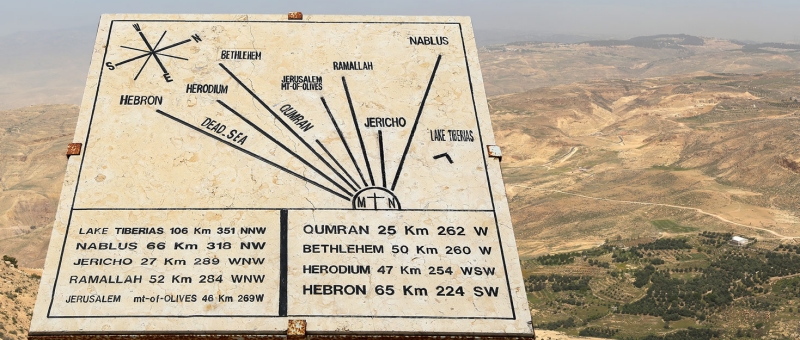
View from Mount Nebo
The story is told in Deuteronomy 34. We've already talked above about the miracle of Moses "being shown" the Promised land.
In verse 4, the Torah narrative comes full circle back to the patriarchs: Then the Lord said to him, "This is the land I promised on oath to Abraham, Isaac and Jacob when I said, 'I will give it to your descendants.' I have let you see it with your eyes, but you will not cross over into it."
As Prager points out (The Rational Bible: Deuteronomy, pp. 503-512), few of us ever get to reach our promised land. Everyone leaves their earthly life with some thing(s) unfinished. We sow but not necessarily reap. That, too, relates to our church vision. We may never see the results though we played a mighty role.
In verse 6, we read that "he" buried Moses in the valley of the land of Moab. As there is no mention of anyone else present, we can figure it was God who buried Moses. Prager suggests that this might be the most touching description of God in the entire Torah. If some person had buried Moses, it is not likely that Moses' grave would have remained unknown.
Moses died on Mount Nebo. But "his eyes were undimmed and his vigor unabated" (verse 7). He did not die of old age. God caused him to die. Not only did he live a long life, he lived it fully vigorous to the end.
The last verse tells that "never again did there arise such a prophet whom the Lord singled out face to face." Prager makes these points about greatness in Moses:
He was steeped in another culture (raised Egyptian).
He loathed injustice (whether to a Hebrew or non-Hebrew).
He knew instinctively what to do (whether speak up, stand up, or even kill).
He had no desire to be a leader (would have loved to remain in Midian).
He began humble and became increasingly more so. Numbers 12:3, "the most humble of all men").
He did not hold on to resentment (Moses interceded with God on behalf of people who spoke against him).
Moses gave up power graciously (Numbers 27:18-23 where Moses laid his hands upon Joshua, thus transferring leadership).
The Torah concludes by pointing out that the Israelites experienced "all these things" firsthand. In a few thousand years, the Jews as well as others of this world would experience Jesus firsthand. When we will see in a such a way again remains to be seen.