Daniel: How To Stand Firm
October 12, 2025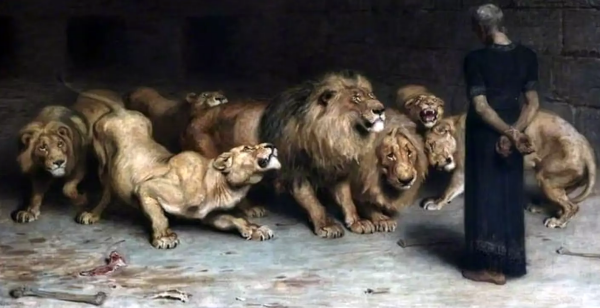
Pastor Patrick presented today's message, "Daniel: How To Stand Firm." A video of today's message is here on YouTube. The discussion that follows assumes you are familiar with the message content.
I had never heard the term satrap before, so my interest was piqued (in a good way). My first surprise was how long the word is: a-khash-dar-pe-neen, אֲחַשְׁדַּרְפַּן). It's also rooted in Aramaic (remember the Book of Daniel is written in both Aramaic and Hebrew). From Biblehub.com, here are some interesting points made about what satrap references teach us as here in Daniel:
Theological Significance
- Divine Sovereignty: God operates through and above imperial structures, turning the schemes of satraps to the promotion of His glory (Daniel 3:28-29; 6:25-27).
- Civil Authority and Faithfulness: Daniel’s interactions with satraps illustrate respectful engagement with government while maintaining uncompromised allegiance to God (cf. Acts 5:29).
- Witness to the Nations: The presence of high-ranking officials at key miracles ensures that the knowledge of the true God permeates administrative networks, anticipating the gospel’s advance “before kings” (Matthew 10:18).
- 1. Stewardship: Effective governance, like that expected of satraps, requires integrity and accountability—qualities exemplified supremely by Daniel (Daniel 6:4).
- 2. Courageous Loyalty: Believers serving under secular authorities may face coercive policies; Daniel and his friends model steadfastness grounded in prayer and trust.
- 3. Influence Through Excellence: Daniel’s superior spirit (Daniel 6:3) earned him favor and a platform for testimony, encouraging Christians to pursue vocational excellence for God’s glory (Colossians 3:23-24).
The other word I heard today, when discussing the satraps, was jealousy ("it can be vicious, destructive"). One of the words for jealousy in Biblical Hebrew is kee-naw' (קִנְאָה). And it is used over and over in a fascinating law in Numbers that ostensibly can uncover a woman's infidelity but is actually a way to crush a man's jealousy. See Numbers 5:11-31, "The Test for an Unfaithful Wife." Read it carefully. The "test" will practically never reveal an unfaithful wife, so in all cases, the man is relie ved of any jealousy. The law protects the marriage, particularly when the unfaithfulness is "undetected" (rumor). How's that for Old Testament cleverness!
What terrific ill-will and human destruction is often born of jealousy by powerful people.
Don't "sign your name" to something that you didn't create (as did King Darius) without very careful review and consideration.
Doing what God wants us to do will often go against what fellow man want or command us to do. Be prepared for the consequences (whichever way you go).
 I'm going to continue commenting on these Daniel messages by referencing the book: Word Biblical Commentary Vol. 30, Daniel by John Goldingay. For chapter 6, see pages 303-328.
This is a familiar "wisdom triangle" - the powerful but witless, the conniving schemers, and the righteous. The schemers are clever enough to fool the stupid, powerful one, but in the end lose to the man of insight.
This is very much a straight line narrative, The word "then" occurs 16 times in the 28 verses (even though it may not be shown in any given translation).
In verse 24, there could have been as many as 500 or more people gathered up and thrown into the lions den. That's a den of considerable size, practically unimaginable.
The chapter has a clear chiastic structure:
1-3 Intro: Daniel's success
4-10 Darius signs the law, Daniel takes his stand
11-15 Satraps plan Daniel's death
16-18 Darius hopes for Daniel's deliverance
19-23 Darius witnesses Daniel's deliverance
24 Satraps meet with their death
25-27 Darius signs a decree and takes his stand
28 Conclusion: Daniel's success
Most of the speech in the story is from the simple (in both senses of the word) plotters. They condemn themselves with their own words. They have the arrogance of a crowd bolstered by their own bravado and folly. And haven't we seen plenty of that these days.
The Torah does not expect a person to pray three times a day, though it did become "a thing" later.
At first blush, chapters 3 and 6 may look very similar. But they're not. The setting is Persian, not Babylonian. The king is manipulated as opposed to acting on his own. The accusers are officials, not experts. Daniel's loyalty to the state is emphasized. Daniel's testing was personal prayer, not public religion. The test concerns what is forbidden, not what is required. Darius is concerned for Daniel, not enraged. Darius accepts Daniel's religious practice rather than trying to persuade him. Daniel makes no statement of his faith. Darius orders the punishment of Daniel's attackers. Darius requires empire-wide worship of Daniel's God rather than mere tolerance of the Jew's religion. The king's confession at the end goes far beyond that of chapter 3.
Goldingay suggests the strict meaning of the word satrap is "protector of the realm" (viceroys, responsible for protection and tribute, etc.). Here, satrap must have a more general, looser sense, "official" kind of meaning.
Having an "attic" big enough for private meetings and guests would be unusual. It suggests a well-to-do-ness on Daniel's part.
There is no suggestion that Daniel is exercising any lordship over the animals. Nor is there any suggestion that the animals have any more sense than expected. It is all God and his angel.
Be wary of governments that oppose religion. They seem themselves as greater than they really are. Those in power can be vain, in cohoots (colluding), or naive. Kings are powerful, but can be manipulated.
People of Daniel's time did not have a special prayer room, or face Jerusalem, or pray as frequently. Presumably this is being introduced as a model going forward.
Darius' references to the "living God" contain seeds of the notion that God not only exists but is active and powerful, awesome and almighty, and involved with human beings.
In Daniel 6, evening suggests the setting of Persian dominion, night is the time of trial, and sunrise is the rising of God's dominion.
Bonus
 Truth and Grace
The issue of how these two concepts relate, truth and grace, came up in a Christmas movie I watched recently: Engaging Father Christmas (2017).
The story centers around a woman born out of an affair. The father is long gone, but his first family is alive and well in a small town at Christmas. They have accepted the woman into their family, and all is great, except that she is sworn to keep the infidelity of the famous patriarch a secret. Eventually they all discover a quote behind some wallpaper that the patriarch left years ago: "May Truth and Grace Reside Here."

Truth must reign supreme. But we also realize that the truth can hurt and/or be embarrassing. That's why the Grace part. As you might imagine, the story ends with the truth coming out and much grace being served up.
It struck me that Truth and Grace are as much of a pair as Love and Law.
Oh, one last point... Don't share big secrets in crowded places, like airports at Christmas time.