Why is Surrender Hard
April 26, 2026Pastor Patrick presented today's message, "Why is Surrender Hard" A video of today's message is here on YouTube. It may help to be familiar with the message but that is not required to enjoy the thoughts below.
This was week #2 in a series on the Lord's Prayer focusing on "Thy kingdom come. Thy will be done on earth as it is in heaven."
I wrote some about this a few years ago: Your Will Be Done.
Another reference from the past... I created a page that compared the two versions of The Lord's Prayer in the New Testament: The Lord's Prayer.
As for the present, I'd like to share some info about the notion of heaven in the Old Testament (OT). Let's start with the word for heaven used right off in Genesis 1:1, "God created the heaven and the earth" (KJV). The word is shamayeem (שָׁמַיִם). There is a very similar Aramaic word used much later in the Old Testament, shamayeen. Shamayeem is actually a plural noun (-eem) from an unused root word suggesting being lofty. In addition to many forms of heaven, the word is also translated as astrologers, compass, earth, horizon, and sky.
The word appears over 400 times in the OT and, depending on context, can be about weather/sky, cosmology (Creation), covenant, or about the end (of times). For some further detailed thoughts, see Strong's Concordance 8064 (scroll down to "Topical Lexicon" in the left column).
The Torah (Genesis through Deuteronomy) is fairly silent about any afterlife. Dennis Prager suggests this is because the Torah is focused on living a godly life in this world and not worrying about the next.
The OT in general, however, does make reference to heaven. But as alluded to earlier with various meanings of shamayeem, there can be many contexts and meanings. One author suggested that the OT focuses more on God's relationship with His people in the present and His sovereignty over all of Creation than in an afterlife kind of heaven.
Shamayeem in the latter parts of the OT definitely carries a notion of God's dwelling place and throne along with angels and celestial bodies. But not so much as an afterlife for humans.
The OT also had a concept of Sheol (NT's Hades). Sheol was for both the righteous ("paradise" or place of comfort) and the sinner (place of torment, Gehenna). Between the two places was a "great chasm."
 Discussions about the afterlife and comparing NT thoughts to OT thoughts invariably bring up the question: "How can/did people that lived before Jesus be saved?" My favorite short answer is: "They had faith in Jesus (or, in their terms, the Messiah) before He came, and we have faith in Jesus who has now come." Also, there does seem to be a clear OT understanding that Man is sinful ("Fallen") and getting back in relationship with God is not easy. That's what all the rituals and sacrifices were designed to help do, atone. One could even say that blood sacrifices made it clear that blood had to be shed to get over this hump, ultimately Jesus' blood.
For more, see 30 Powerful Bible Verses About Heaven in the Old Testament. Sections include: the nature of heaven, the promise of eternal life, the righteous will inherit heaven, God's faithfulness, the beauty of heaven, heavens joyful worship, the assurance of heaven's entrance, and the reassurance of God's presence.
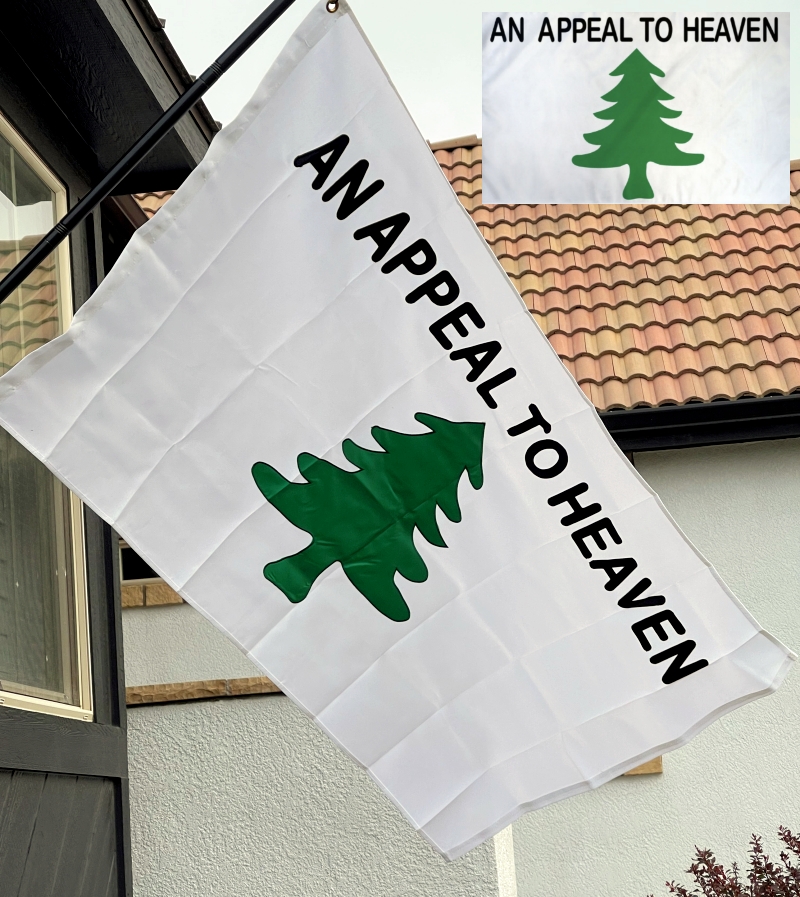
One last tangential note... There was a flag in the history of the United States referred to as the "An Appeal to Heaven" Flag (pictured above at right). This flag was first used on a fleet of six schooners in 1775 authorized by George Washington. More...
Bonus
Science and God
Prager University has released a 5-minute video series called Science and God.
Do science and religion conflict? Or does science reveal something about God? Has God made science possible, even desirable from God's point of view?
 Here are some of the individual titles:
- What Is Intelligent Design?
- How Did the Universe Begin?
- What's Wrong with Atheism?
- Are Religion and Science in Conflict?
- Aliens, the Multiverse, or God?
- Evolution: Bacteria to Beethoven
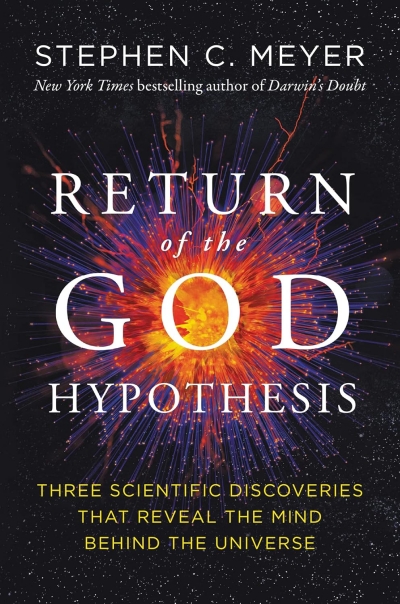
These first five videos are presented by Stephen Meyer, author of Return of the God Hypothesis: Three Scientific Discoveries That Reveal the Mind Behind the Universe. It's a little thick and a little deep, but well worth the read.
Enjoy.
Bonus2
Only Takes 67 Hours to Read the Bible
Reading at an average rate of 200 words per minute, it will take about 67 hours to read through the entire Bible (Old and New Testaments). Of course, the translation you use will matter as they each have a different number of words. But roughly, 67 hours is it.
While stumbling onto this bit of trivia, I also found a guide to read the Bible chronologically. BibleGateway.com makes a chronological list available: Chronological Bible Reading Plan (61 Days) (note they spread it over 2 months).
I was surprised at how much less time it would take than I expected. Maybe that's because most Bible reading courses are designed for a year which strikes most people as quite a project. But, to read the Bible in a year takes only about 11 minutes per day.
The kicker is that getting the most out of the Bible takes far more than just reading it.