The Father You've Always Needed
December 14, 2025Pastor Josh Starnes presented today's message, "The Father You've Always Needed." A video of today's message is here on YouTube. It may help to be familiar with the message but that is not necessary to enjoy the thoughts below.
The third appellation in Isaiah 9:6, Everlasting Father, is but one word in the Hebrew text, unlike the other three which are two words each. The word is aviad (ah-vee-ahd, אֲבִיעַ֖ד). The one-versus-two-word difference can be shown with a last name example: Goodman. It's not Good Man. And like the last name example just given, the one-word name is in fact what we would call a compound word made up of one word meaning forever, ad (עַד), and another word meaning "my father," avi (אָב). Pastor Josh noted that this particular word is used only once in the Hebrew Bible, right here - Isaiah must have made it up for this purpose. He also pointed out that there are other Hebrew Bible words for father used frequently that Isaiah could have used, abba and av (which can also refer to ancestors).
In addition to this seemingly "what difference does it make" tidbit, there is a surprising amount of discussion regarding what the name Everlasting Father means or suggests. Rather than try to explain what I mean by that, I'll simply share one of many articles that express opinions about what it means and why. Ever heard of the term theophoric? Neither had I. A theophoric name carries a reference to God along with something about God's nature or character. It doesn't mean the person is God. So, here's one somewhat lengthy article that argues for a theophoric approach to "Everlasting Father": Isaiah 9:6 Explained: A Theophoric Approach. (As Pastor Josh would put it, "this is some serious nerding out on scripture."
If you didn't choose to read the article, I'll just give you a list of the translations that have been offered: Everlasting Father, Father of Eternity, Father Forever, Father for All Time, Father of the Eternal Age, etc.
Others argue about why the Son is being called the Father. This often comes down to "father" being more like "king." The tense is also argued, too. Is it "his name will be called" or "has been called"? Ever heard of "prophetic past tense"? Yeah, me neither. And who is doing the naming? Is it father like bio-dad or father like Ben Franklin was the father of electricity? To follow someone, follow in their footsteps, is to grant fatherhood in some sense to the person being followed. Does eternal go in both directions, or could there be a beginning and then last eternally into the future?
Using the Jewish Publication Society, Goldingay, and Williamson, the author of the above referenced article suggests this translation of the four names: "The warrior God is a miraculous strategist; the eternal Father is the ruler who brings peace.">BR>
Pastor Josh made the important point that who your father is matters a great deal "Who you are depends on whose you are." This reminds me of the natural consequences that cause "blessings and curses" to follow for generations from having had good or bad parents (Exodus 34:6-7 and Deuteronomy 5:8-10). Read more about that in "Think Wisdom, not Law."
Bonus
O Come, O Come Emmanuel
Last week I talked a bit about a 7-Week Advent. I'd like to add to that this week by talking a bit more about antiphons, particularly O Antiphons.
Ever wonder where the 'O' comes from in O Come, O Come Emmanuel? It's not just an expression, like oh my, but rather comes from the O Antiphons (in Latin) from somewhere in the 6th to 8th Century AD. Antiphons are snippets of prayer put to music that can precede, follow, or even be in the midst of larger religious texts (e.g. Psalms).
The Christmas hymn/carol, O Come, O Come Emmanuel, is based on the seven antiphons of a 7-week Advent season (or in some cases, the seven days leading up to Christmas Day). We used the summary below for a Family Dinner (our Shabbat) topic.
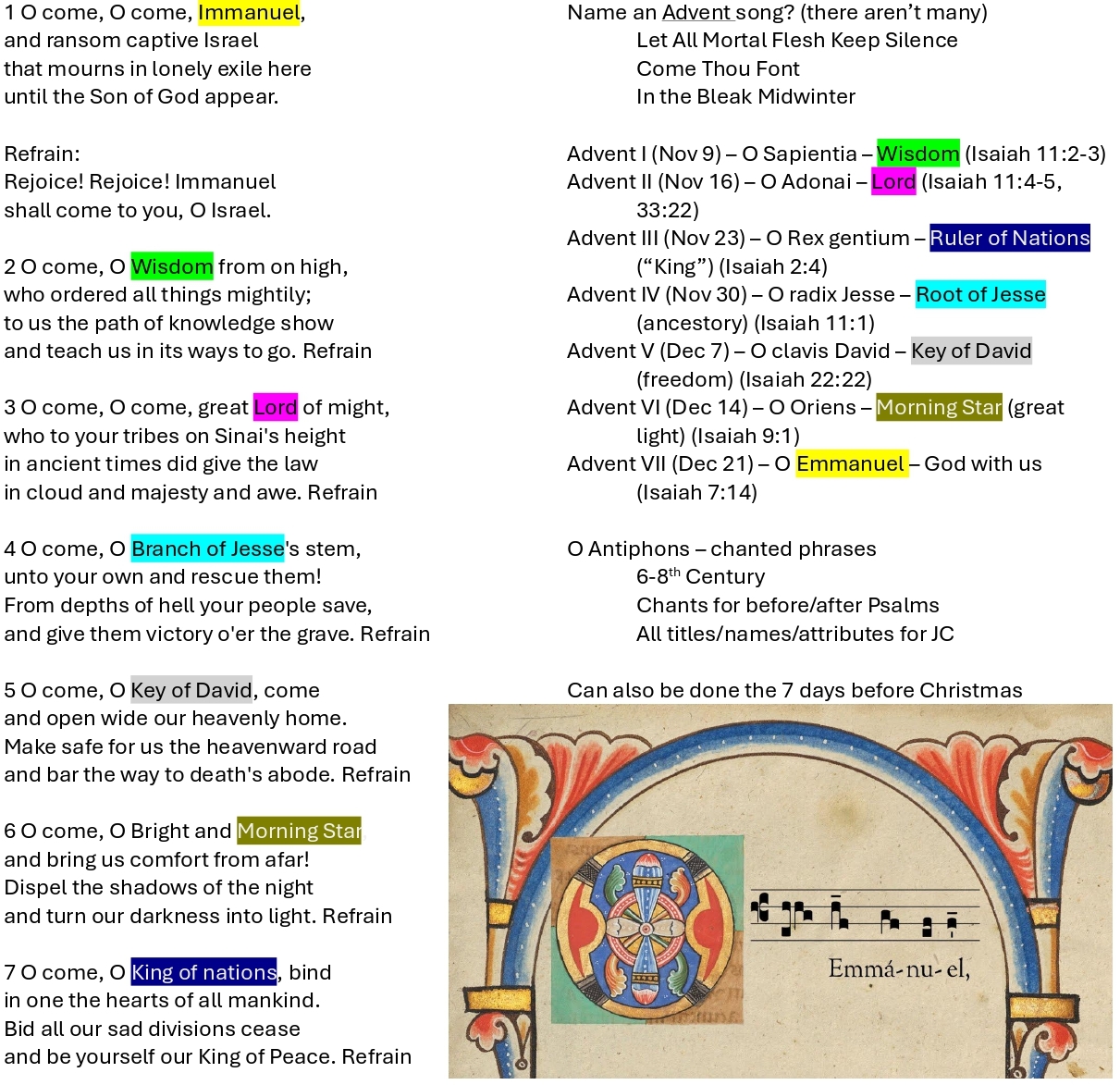
Note there are only four lines on the musical staff. I could not find what the "notes" before "Emmanuel" indicated. If it's at all like notations today, it's either time signature and clef and/or a musical intro to the singing itself. I did find that the singing notes (above the syllables of the word), are, in fact, the notes for the singers. Whether a single note or multiple notes attached directly above a syllable, they are to be sung in one breath. If a single note, it's a single pitch on that syllable. If two notes are directly above each other (like "nu"), the notes are sung consecutively starting with the lower note (still all in one breath). If the two notes above a syllable are offset (like with "Em" and "ma"), they are sung from the top note descending to the lower note (again, all in one breath). That's about all I know about medieval music notation.
Bonus2
Re-Gifting God
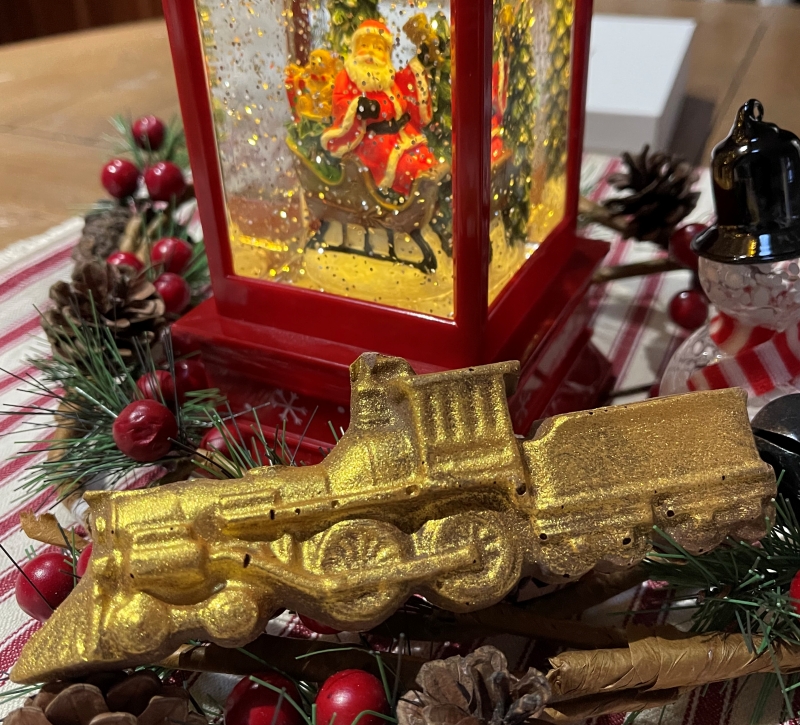
A dear friend from church came up to me yesterday and said, "I have something to re-gift to you" and handed me a small, fancy, white box. Okay... In it was the gold-dusted chocolate locomotive pictured above. It actually was a perfect gift for me as it hit two of my favorite things at once: chocolate and trains.
Two thoughts struck me about this act of kindness and thoughtfulness.
One is to share God's provisions wisely. It's a matter of getting exactly what's needed to the person that needs that exact thing at that moment. And if that means some "re-gifting," so be it.
The other is to share God Himself. The issue is not so much what's needed in an earthly sense, but rather what's needed in a spiritual sense. It's hard to beat the peace and comfort God offers to individuals regardless of their situations. Often in spite of their situations. Assuming you've been gifted that already, why not re-gift it to someone else. You won't be giving it up yourself, you'll simply be multiplying the effect.
From chocolate locomotive to passing the peace. How about that!