Daniel: Reflecting God's Glory
October 5, 2025Pastor Josh Starnes presented today's message, "Daniel: Reflecting God's Glory." A video of today's message is here on YouTube. The discussion that follows assumes you are familiar with the message content.
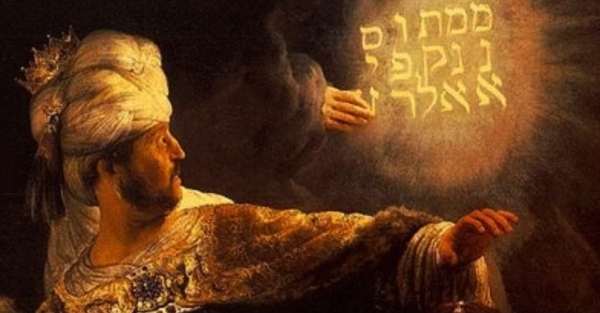 At right is envisioned Belshazzar seeing the handwriting appear on the wall. The Hebrew is written top to bottom (unusual) as well as right to left (usual). So, the first two columns on the right are identical and read "MeNE MeNE." The next column to the left reads top-to-bottom "TeQeL." And the last word on the left spans two columns, again top-to-bottom and right-to-left, and says "U(and)PaR | SIN." These are clearly Hebrew letters in this image, but the Bible does not say in what language the words were written. In any case, Daniel was given power by God to interpret them.
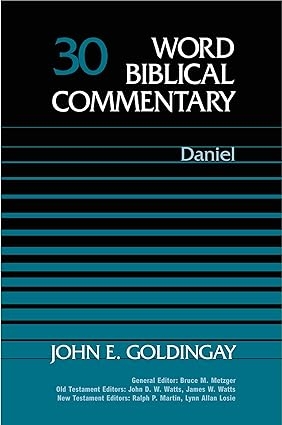 I'm going to continue commenting on these Daniel messages by referencing the book: Word Biblical Commentary Vol. 30, Daniel by John Goldingay. The World Biblical Commentary is quite a series of commentaries on various books of the Bible. I like how the discussion of each chapter is laid out:
- 1. An extensive Bibliography.
- 2. Author's own English translation including a significant number of Notes concerning specific words and usages.
- 3. Form, Structure, and Setting
- 4. Comments and Explanations
On the surface, the words refer to weights. A mina (about 1 pound), a shekel (about 20 pounds), and a half (likely a half-shekel). Together, it would be like a merchant yelling out prices for various quantities. Allegorically, the phrase could refer to Babylonian kings. Further, mina can mean "appoint" or "destine" in addition to a count. The "half" may refer to Belshazzar's kingdom being broken apart.
Belshazzar's father was Nabonidus, not Nebuchadnezzar. It is possible Nabonidus married into the Nebuchadnezzar family thus connecting the families. It could simply refer to succession, too. The key to understanding this story is that Babylon rose under Nebuchadnezzar and fell during Belshazzar. Interestingly, Nebuchadnezzar did have an actual son and successor Amel-Marduk who also came to a violent end.
Goldingay points out several Hebrew words in the text that carry a meaning of a divine connection whether a gift of understanding, interpretation, or the like. These include insight, ability, expertise, knowledge, keen mind, enigma, and puzzles.
It's also pointed out that Belshazzar calling for Daniel as a last resort is reminiscent of the Pharoah in Egypt who knew not Joseph.
At the end of Daniel 5:23: "But you did not honor the God who holds in his hand your life and all your ways." The "ways" of a person are the course of life throughout their life which is seen as "under God's control." This does not imply a lack of freewill. I would say more like "keeping to a pathway."
I had never stumbled onto the word paronomasia before. It basically means "pun" or simply a play upon words that contradict each other. In this case, it was not a display of wit but rather the perception of hidden meaning.
The book points out (as I did when I did a short course "The Four Times God Writes in His Own Hand") that it is unclear whose hand does the writing. There is clearly something supernatural about it, but the text does point out it's a "human hand." Like dreams, this lacks clarity and needs an interpreter.
When it seems all is going very well for you, the moment God says "you fool" is the moment you must fear. (Luke 12:20)
Bonus
 Blessing of the Animals
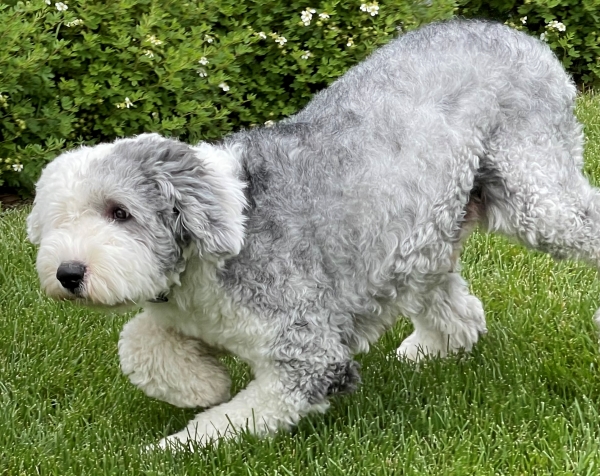
Pictured at right is the latest addition to our family, a 2.5-year-old Old English Sheepdog named Bonnie Lass which means Pretty Girl in Scottish. There is indeed some Scottish blood in our human family as well. Whit's fur ye'll no go by ye (What will be, will be).
And it just so happens that a few days ago (October 4th), the Catholic Church (mostly) observed the Feast of St. Francis which is also used as the time for the Blessing of the Animals (on a per church basis). There is some debate amongst the faithful as to whether or not animals should be blessed. Animals are not as high as humans on the Judeo-Christian hierarchy.
But it is also true that God blessed the animals at Creation. Genesis 1:22 reads "God blessed them and said, 'Be fruitful and increase in number and fill the water in the seas, and let the birds increase on the earth.'" In verse 25, God saw that the Creation of all the animals was good. And God ultimately put Man in charge of stewarding the creatures of Creation.
Don't forget that the animals were saved from the Flood, too.
Most blessings for animals include both a sense of the work they do for Man and for feeding Man, but also providing for our needs. This "needs" category includes teaching children how to care for others, companionship, and consoling. And don't forget rescue animals that perform a myriad of rescue operations.
Some Bible verses suggest that the animals may naturally be better than Man at living out their lives. See Jeremiah 8:7, "Even the stork in the sky knows her appointed seasons, and the dove, the swift and the thrush observe the time of their migration. But my people do not know the requirements of the LORD."
God feeds them all (Matthew 6:26).
Proverbs 12:10a, "The righteous care for the needs of their animals."
Job 12:7-10, "But ask the animals, and they will teach you, or the birds in the sky, and they will tell you; or speak to the earth, and it will teach you, or let the fish in the sea inform you. Which of all these does not know that the hand of the LORD has done this? In his hand is the life of every creature and the breath of all mankind."
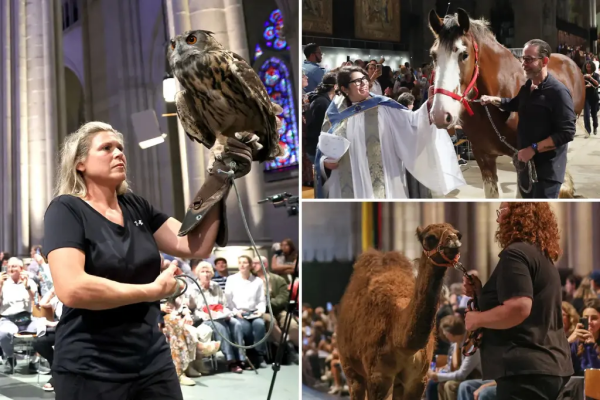
Some churches go all out, including some rather exotic animals.
Bonus2
Sukkot - Festival of Booths
The Festival of Sukkot (Sue-COAT, סוּכּוֹת) in the Jewish world is right now (October 6-13, 2025). It's also known as the Season of Rejoicing. It remembers the 40 years the Israelites spent in the Wilderness, living in make-shift tents, and very limited diets. It also celebrates the harvest. It's sometimes referred to as the Feast of Tabernacles but it really has nothing to do with the Tabernacle.
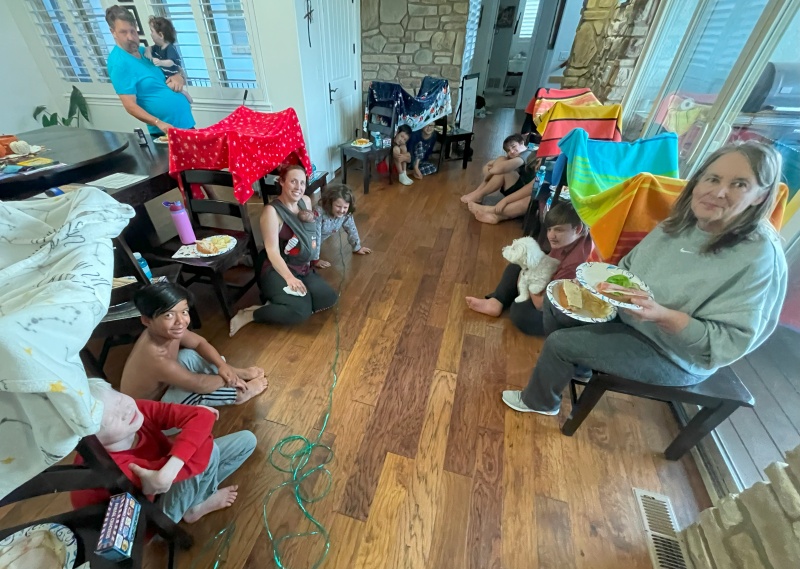
We'll have our Family Dinner this week in our sukkahs (blankets/cloth over chairs) and study the Exodus a bit.
The Festival of Sukkot is described in Leviticus 23:33-44.